
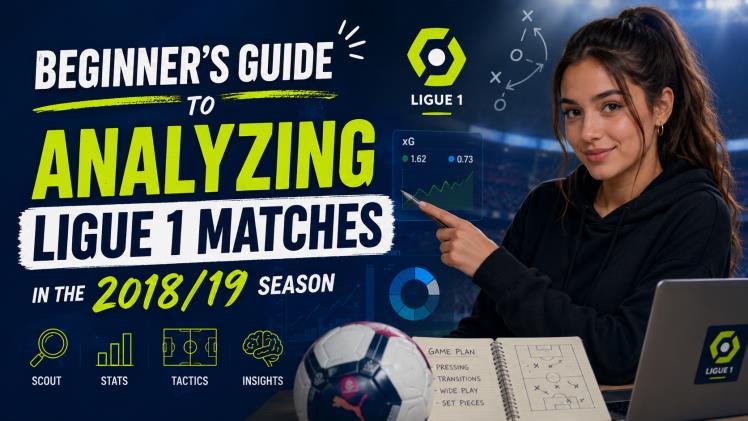
For newcomers exploring football betting, France’s Ligue 1 during the 2018/19 season offers a valuable case study. Its mix of dominant teams, unpredictable fixtures, and tactical variation makes it ideal for learning how to evaluate matches logically. This guide looks at what data to consider, why context matters, and how beginners can turn observation into structured reasoning.
Understanding the Foundation of Match Analysis
Every analysis starts by separating perception from evidence. In Ligue 1, the gap between Paris Saint-Germain and the rest of the league creates misleading benchmarks for form and probability. New bettors often overrate perceived “strength” without testing whether data supports it. By focusing on patterns beyond results—expected goals (xG), chance quality, and tactical balance—beginners learn to replace intuition with measurable logic.
The Key Metrics to Track Consistently
Numbers tell stories faster than intuition, but they must be interpreted within context. The most effective data points for Ligue 1 include possession chains, shots on target, and defensive errors.
| Metric | Why It Matters | Typical Red Flag |
| Expected goals (xG) | Measures chance quality | Consistent xG deficits despite wins |
| Ball possession | Indicates control levels | High possession with poor final-third entries |
| Defensive duels won | Reflects stability | Drop across consecutive matches |
For beginners, tracking three or four metrics consistently across four-game periods helps anchor interpretations. Context—injuries, home vs away, and pressure situations—transforms these figures from raw numbers into predictive indicators.
Reading Tactical Styles for Pattern Recognition
H3: Ligue 1 Team Categories
During 2018/19, teams broadly fit into three styles:
- High-pressing expansives (e.g., Marseille, Lyon) that create volatility.
- Structured counter-attackers (e.g., Lille, Nice) that rely on transition timing.
- Reactive units (e.g., Reims, Nîmes) that force opponents to attack into compact spaces.
Identifying which style clashes produce open games or low-event matches helps shape betting interpretation. Over time, new bettors start connecting tactical setups to expected match flow and risk level.
Avoiding Common Beginner Traps in Ligue 1 Betting
Many novice bettors fall for immediate narratives: big clubs always winning, small clubs always losing. But French football’s mid-table volatility challenges that assumption. New bettors benefit from checking team performance post-midweek fixtures, as fatigue significantly impacts smaller squads in Ligue 1. Recognizing these situational disadvantages often reveals hidden opportunities not yet priced by markets.
Applying Contextual Reading Through UFABET Insights
When evaluating betting probabilities, analysts using the ufabet168 web-based service observed variations between public sentiment and factual performance. During the 2018/19 campaign, underdog teams often held stronger xG trends than odds implied. By comparing these patterns inside a large-scale betting interface, beginners could understand how market prediction lags behind tactical insight. The key takeaway is that learning to interpret football probabilistically requires patience: odds reflect consensus, not truth. Monitoring these discrepancies provides beginners an education in real-world betting logic.
Integrating casino online Resources for Match Simulation
Beginners who used analytical tools through a casino online framework discovered useful modeling advantages. By simulating goal probability based on past fixture data, they could visualize scoring likelihoods, defensive exposure, and variance bands before committing to wagers. This exercise established discipline in assessing value rather than relying on gut feeling. Through structured simulation, new bettors understood that match evaluation isn’t guessing—it’s filtering uncertainty into manageable probabilities using repeatable data points.
Building a Step-by-Step Method for Consistent Analysis
For effective learning, beginners should adopt a sequential routine.
- Examine previous three matches for performance stability.
- Cross-check underlying metrics against results to spot overperformance.
- Identify tactical tendencies—pressing, tempo, directness.
- Project how these traits interact in the next matchup.
Applying this framework consistently conditions analytical thinking. Over time, it builds instinctual caution against emotional or narrative-driven choices while nurturing a data-first mindset.
Recognizing Where Analytical Reading Can Fail
No model fully predicts variance. Red cards, weather, and unexpected tactical shifts cause deviations. The role of a beginner analyst isn’t eliminating unpredictability, but anticipating where uncertainty clusters—such as derbies or fatigue-sensitive fixtures. Acceptance of error sharpens judgment, reinforcing risk management over blind confidence.
Summary
Ligue 1’s 2018/19 season provides a compact model for learning football analysis. Its tactical diversity and frequent upsets train new bettors to think statistically rather than emotionally. By combining base metrics, contextual reading, and structured simulation tools, beginners progress from reactive guessing toward measured evaluation. The essence of smart betting lies not in predicting every result correctly but in understanding why certain outcomes were ever probable in the first place.