
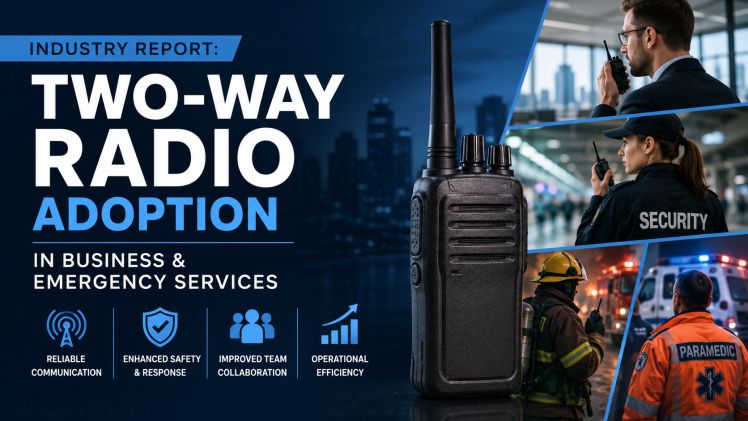
The prediction seemed inevitable.
Smartphones were taking over the world. Messaging apps were multiplying faster than anyone could keep track of. Every year brought another communication platform promising to revolutionize how people stayed connected.
Meanwhile, some industry analysts quietly assumed the two-way radio was living on borrowed time.
Then something unexpected happened. Businesses kept buying them. Emergency services kept relying on them. Large organizations kept expanding their communication networks.
In other words, the technology everyone expected to disappear simply refused to leave. And when you look closely, it’s not hard to understand why.
The Great Communication Reality Check
Here’s a question worth asking.
What do construction crews, logistics companies, security teams, manufacturing facilities, and emergency responders all have in common?
They can’t afford communication delays. Not really.
A missed text might be annoying. A delayed email might be inconvenient. A voicemail sitting unheard for thirty minutes could create operational problems that ripple across an entire organization.
That’s where the two-way radio continues to shine. Push the button. Share information. Move on. No waiting. No scrolling. No wondering whether someone checked their notifications.
It’s almost suspiciously efficient.
Businesses Are Chasing Speed, Not Gadgets
Contrary to popular belief, most organizations don’t adopt technology because it’s exciting.
They adopt it because it saves time. Or money. Preferably both.
Across industries, communication speed has become a competitive advantage. Teams that share information quickly often make faster decisions, coordinate more effectively, and respond more efficiently to changing conditions.
A modern two-way radio helps support that objective by reducing communication friction.
Less waiting. Less chasing people down. Less “Did you get my message?” Frankly, nobody misses that conversation.
Construction, Logistics, and Security Lead the Charge
Some industries have become especially enthusiastic adopters. Construction companies rely on communication to coordinate crews spread across large job sites.
Logistics providers manage drivers, deliveries, warehouses, and schedules that change throughout the day. Security teams operate in environments where information often needs to move immediately.
Notice a pattern? These industries aren’t looking for entertainment features.
They’re looking for reliable communication. The two-way radio delivers exactly that. Which explains why adoption continues to remain strong.
Emergency Services: The Ultimate Stress Test
If you want to know whether communication technology works, don’t ask the marketing department. Ask emergency responders.
Emergencies have a remarkable way of exposing weaknesses.
Poor audio quality? Problem.
Communication delays? Problem.
Complicated user interfaces? Big problem.
That’s one reason emergency services continue placing enormous trust in two-way radio communication. The technology prioritizes immediacy, group coordination, and operational simplicity, three qualities that become incredibly valuable when situations evolve quickly.
The fewer obstacles between information and action, the better. It’s hard to argue with that logic.
The Shift Toward Larger Communication Networks
Something else is happening across multiple industries. Operations are becoming more distributed.
Teams work across cities. Projects span multiple regions. Organizations manage personnel spread across vast geographic areas.
The traditional model of local-only communication is no longer enough for many businesses.
As a result, modern two-way radio technology is increasingly evolving toward broader communication capabilities that support larger teams and more mobile workforces.
Because business stopped being local a long time ago. Communication is simply catching up.
Technology Is Evolving Quietly
Here’s the funny part. Many people still picture a radio from twenty years ago when they hear the term two-way radio.
That’s a bit like imagining every car still uses a cassette player. The exterior may look familiar. The technology underneath is dramatically different.
Today’s communication systems increasingly feature enhanced coverage options, improved audio performance, larger group communication capabilities, stronger security measures, and more flexible deployment models.
The user experience remains simple. The technology behind it has become considerably smarter. That’s usually a sign of progress done right.
The Numbers Point in One Direction
While communication tools continue to evolve, industry adoption patterns reveal something important.
Organizations are not abandoning push-to-talk communication. They’re modernizing it.
Businesses continue investing in systems that prioritize speed and reliability. Emergency services continue relying on communication methods built around immediate information sharing.
Why? Because the core need hasn’t changed.
People still need to communicate quickly. The tools simply keep improving.
The Bottom Line
The ongoing adoption of the two-way radio across business and emergency services highlights a simple reality: reliable communication never goes out of style.
As organizations become larger, more mobile, and more dependent on real-time coordination, demand for instant communication continues to grow. The technology supporting that communication may evolve, but the need itself remains remarkably constant.
Because trends come and go. The need to get the right information to the right people at the right time doesn’t.